
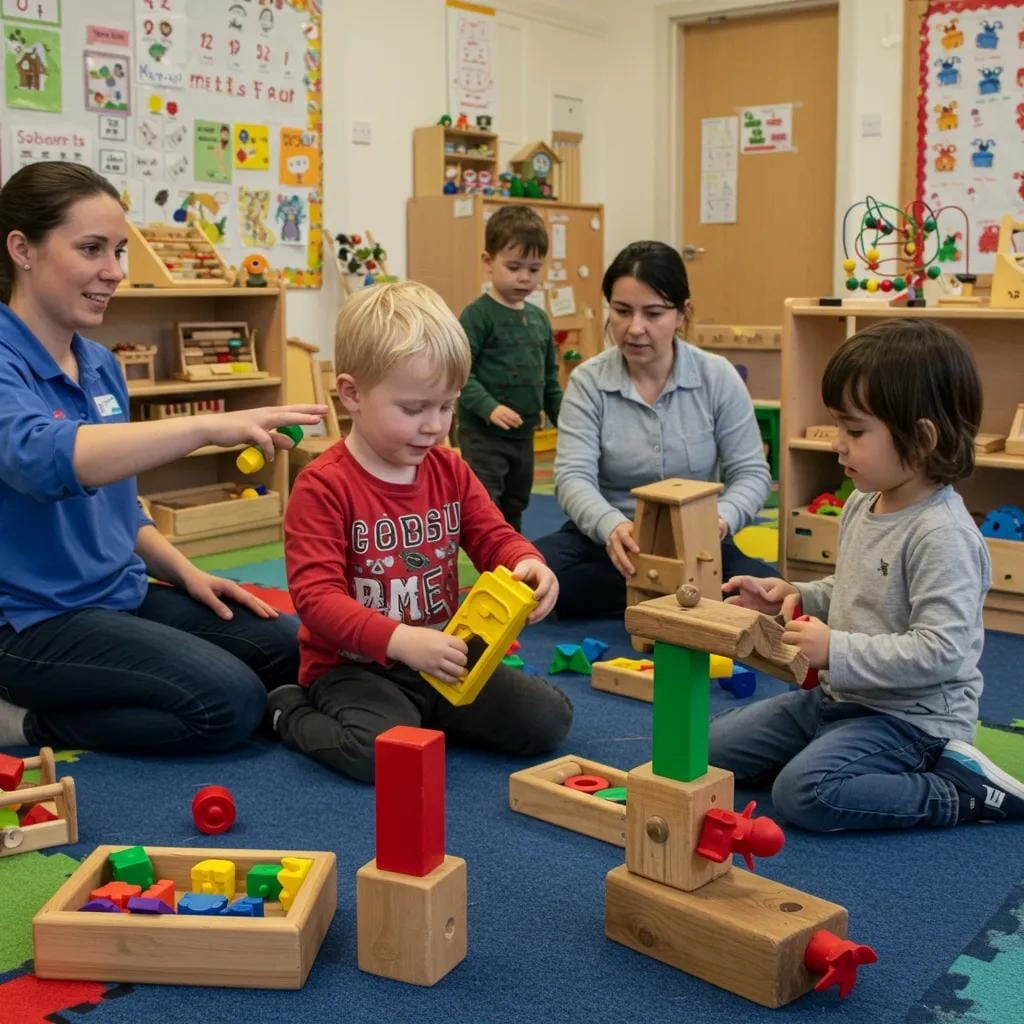
Academic readiness involves more than early exposure to letters and numbers. In a well-planned early learning programme, children practise listening, communicating, solving problems and managing everyday tasks while they play. These experiences help them approach classroom routines with confidence and curiosity. Readiness develops at different rates, so educators observe each child and build on current interests. These foundations become clearer when learning is considered across several connected areas of development.
Learning Through Purposeful Play
Play gives children chances to test ideas, make choices and revise a plan. In an early learning kindergarten setting, activities such as building with blocks or sorting natural objects invite children to compare, count and explain what they notice. Educators can extend the play with a question, new material or time to try again. The child practises thinking before worksheets enter the picture.
Children also learn to explain a plan when they describe what they are making or why a structure fell. Educators can introduce words such as taller, heavier or beside during the activity. This connects spoken language with concepts that appear later in books, instructions and classroom discussion.
Language Grows Through Conversation
Daily conversations give children practice listening, taking turns and expressing an idea clearly. Educators can ask open questions about a story or activity, then allow time for an answer. A child who explains what happened first and what came next is practising the sequencing used in reading and writing.
Songs, stories and group discussions introduce new vocabulary in context. When adults respond to a child’s words with a follow-up question, the exchange encourages fuller answers. Children also learn that communication includes listening to another person, not just waiting to speak.
Early Maths Builds Useful Thinking
Early maths appears in ordinary play. Children compare quantities, notice patterns, sort objects by shape and work out how many pieces a game needs. These tasks build number sense and encourage careful observation without requiring formal calculations.
Educators can prompt children to predict what happens next in a pattern or explain how they divided materials among a group. Such questions make thinking visible. Children practise trying a method, checking the result and adjusting their approach when the answer does not fit.
Routines Support Classroom Independence
Simple routines help children manage materials and move between activities. Putting away a puzzle, collecting a bag or following a short set of instructions gives practice in remembering what to do and completing a task.
A predictable day also gives children chances to make small decisions. They learn to choose an activity, ask for help and prepare for a transition. These habits support participation in a classroom, where children are expected to manage belongings and follow shared routines.
Social Learning Prepares Group Work
Group activities teach children to share resources, wait for a turn and contribute to a common task. A block-building project, for example, gives children a reason to discuss ideas and resolve differences. These interactions also help them practise listening to instructions from both peers and educators.
Disagreements provide opportunities to name a problem and consider possible solutions. With calm guidance, children learn to explain what they need and hear another person’s view. Those skills support group learning, where children must cooperate while pursuing their own ideas.
Observation Guides Next Learning
Educators learn about a child’s progress by noticing how they approach activities, communicate and respond to challenges. These observations help identify interests and skills that need more practice. A child who enjoys sorting objects, for instance, can explore patterns or compare quantities through new materials.
Regular observation also helps educators adjust the level of challenge. They can offer a new question, break a task into smaller steps or give a child more time. Learning then builds on what the child can already do, rather than relying on a fixed pace for everyone.
Conclusion
Families can support readiness by noticing what holds a child’s attention and making room for conversation, stories and simple responsibilities at home. A child who sorts laundry, explains a drawing or waits for a turn is practising skills used in group learning. These moments do not need to resemble formal lessons. When choosing a programme, ask how educators observe progress and adapt activities, then consider whether that approach matches the child’s current needs.


